Today, I received a notification from Dropbox about an update for the Windows app, so I went ahead and installed it.
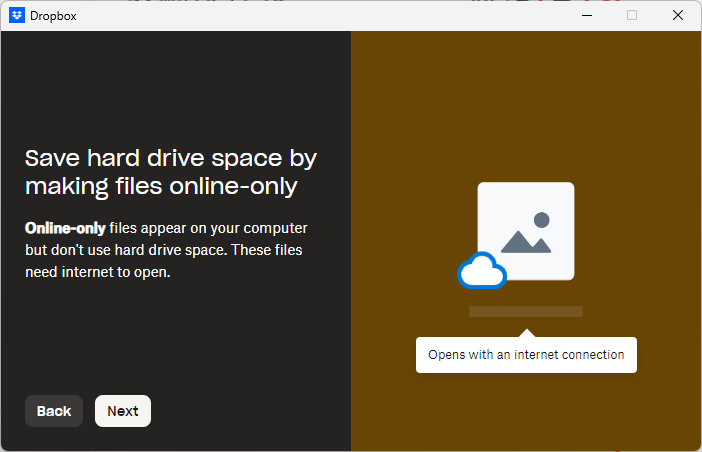
To my surprise, Online-only mode is now available even on Dropbox’s free plan.
Very nice!
When you set files to Online-only, they’re not stored on your local device, so they don’t take up any space on your hard drive or SSD. You simply download a file from your online storage when you need it, and then open it.
This feature itself has existed in Dropbox, but as far as I remember, it was limited to paid plans.
By the way, Microsoft’s OneDrive also offers a similar (the same, I think) feature, and it has been extremely useful on devices with smaller storage capacity. I always wished Dropbox had it too, but since I was on the free plan, I couldn’t use it.
Because of that limitation, I avoided installing Dropbox on storage-limited devices and accessed it through the browser only when necessary. But with this latest update, I can keep Dropbox installed without filling up my storage, search for my files anytime, and download them only when I need them.
This update is truly a happy-making to me.
Today’s Japanese: “ちなみに (chinami ni)” ≒ “by the way”
“Chinami ni” is written in kanji as 「因みに」. The verb 「因む(ちなむ)(Chinamu)」 means “to be related to” or “to have some connection with.” So, “chinami ni” is a phrase used when adding supplementary information related to the topic being discussed. This is because that I use [≒ “by the way”]. It is not really meaning equal, but kind of equal. The information that follows “chinami ni” is usually not essential for the conversation to continue, but having it often helps deepen understanding. On the other hand, it’s also common for conversations to drift away from the main topic after someone says “chinami ni.” For example, in meetings, you often hear questions like “By the way, how does that look from A’s perspective?”—questions that seem somewhat necessary but aren’t really essential, actually. You may know meetings like this.
Today’s English: “Only (オンリー)” “Only” can mean “just,” “limited to,” or “exclusive,” and it’s used both as an adjective and an adverb. It narrows down or emphasizes the scope of something, like “There’s only one thing I want to ask,” or “This is only for you.” You also often hear the expression “If only ~,” which carries the nuance of “I wish I had…”.
Chinamini, in the Japanese TV and music industries — as well as in video and music production — there’s an industry term called “オンリー” (only). It refers to situations where part of the necessary material has to be recorded separately or independently due to unavoidable circumstances, or to the separately recorded material itself. I wonder if people still use that term today…. If there’s any modern youth slang in English that uses “only,” I’d really like to know. Please tell me!
Experienced in various creative productions such as magazine, video, and web production, advertising, sales promotion.
Currently, I am engaged in these fields as a freelance with a business name of Zatta Production.
This site introduces useful services that I've used or discovered.